
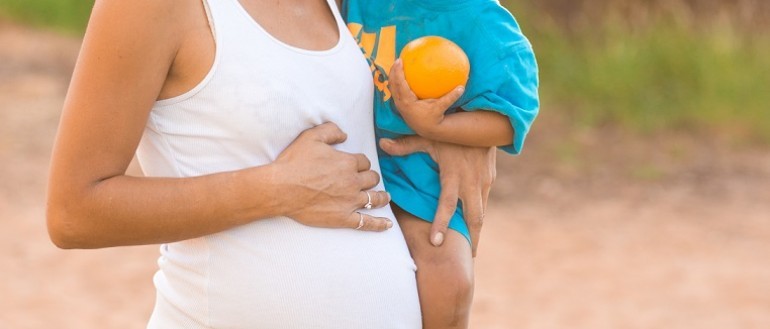
Aims:
- To assess outcomes of women with and without hyperglycaemia in pregnancy in the NT and their children.
Summary:
PANDORA is a longitudinal birth cohort study of mothers and their children that will assess outcomes of diabetes in pregnancy in the NT including high-risk Aboriginal women and their children.
The results of this study will contribute to policy and clinical practice guidelines on the management of diabetes in pregnancy and follow-up of mother and baby. The study will also inform the design of further work to reduce risk of future obesity, diabetes and cardiovascular disease in both the mothers and children.
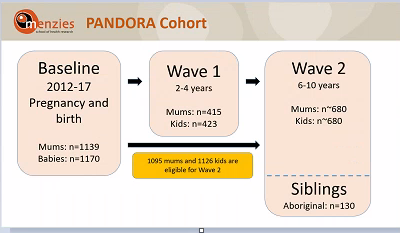
PANDORA Baseline (2012 – 2017)
Recruitment commenced in 2012 and was completed in February 2017. Over 1100 women and their babies, with and without diabetes in pregnancy, were recruited during pregnancy across all NT regions. Participants included women with any type of diabetes in pregnancy (type 1 diabetes, type 2 diabetes, gestational diabetes mellitus) and women without diabetes in pregnancy and their children. Approximately 50% of PANDORA women are Aboriginal and/or Torres Strait Islander women. Our cohort is unique for the high proportion of mothers with pre-existing type 2 diabetes in pregnancy.
The baseline study involved the collection of pregnancy and birth information, and undertaking measurements including cord blood and detailed neonatal body fat assessments.
PANDORA Wave 1 (2016 – 2018)
PANDORA Wave 1 involved follow-up clinical assessments ~2-4 years after baseline of a sub-group of Aboriginal and Europid PANDORA mothers and their babies. Participants were eligible for Wave 1 if at baseline the PANDORA mother had type 2 diabetes, gestational diabetes mellitus or no DIP, and 415 mothers and 423 babies participated.
PANDORA Wave1 aimed to examine cardio-metabolic risk factors in these mothers and their infants in order to identify predictors of chronic disease such as obesity, diabetes and heart disease later in life. We will use information from Wave 1 to assess the maternal and infant consequences of diabetes in pregnancy to then inform the timing and types of interventions to prevent the development of later chronic conditions.
The Wave 1 study involved detailed assessments of both the mother and her child which included: measurements of body size and blood pressure, collection of blood to measure glucose, cholesterol levels markers of inflammation and assessment of epigenetics. Additional assessments for the child included: ultrasound of the aorta blood vessel, body fat measurements (bioimpedance and skin folds), and a developmental assessment. The mothers also completed questionnaires about her and her child including demographics, smoking and alcohol use, nutrition, physical and mental health, and about her child’s development and well-being.
PANDORA Wave 2 (2019 – 2024)
PANDORA Wave 2 is the next follow-up phase of the PANDORA cohort, where all mothers and children 5½ -13 years of age/post-partum will be invited to participate in a health examination. The cohort will also be broadened to include a group of brothers and sisters (6-16 years) of Aboriginal PANDORA children who will be invited to participate.
Study assessment commenced in late 2019 and will continue until mid 2024, to cover the age range of the cohort. Ethics approval has been received from both Top End and Central Australia committees of the NT.
The Partnership has received letters of support from Aboriginal Medical Services Alliance Northern Territory (AMSANT) and two large Aboriginal controlled urban health services; Danila Dilba Health Services and Central Australian Aboriginal Congress. We are in the process of contacting other NT Aboriginal Community Controlled Health Organisations to discuss the study and request their support.
We have approval from the NT Government Health Services to work with remote clinics in both Top End and Central Australia and the hospitals for access to medical records.
PANDORA Mothers
This sub-study involving PANDORA mothers was completed in 2016. It assessed whether enhanced post-pregnancy support for Aboriginal and Torres Strait Islander women with diabetes in pregnancy improved uptake of recommended health checks post-partum. The study also identified the enablers and barriers to undertaking the recommended post-pregnancy health checks. Results have been published (see publications Kirkham et al. ANZJOG 2019).
PANDORA contacts:
Email: pandora@menzies.edu.au or phone (08) 8946 8497
Further information can be accessed through the project website here.
Chief investigator:
Epidemiology Group Head:
Project manager:
Project dates:
The PANDORA study is a longitudinal study, which commenced in 2012. The current wave of data collection is due for completion in mid 2024.
Further information for participants can be found here.
Funders:
- National Health and Medical Research Council (NHMRC).
Collaborators:
- AMSANT
- Healthy Living NT
- Baker IDI Heart and Diabetes Institute
-
Northern Territory Department of Health.
- Newsletter June 2017
- PANDORA Newsletter - December 2015
- NT Diabetes in Pregnancy Partnership Project Newsletter - December 2015
- NT Diabetes in Pregnancy Partnership Project Newsletter - September 2014
- NT Diabetes in Pregnancy Partnership Project Newsletter - May 2014
- NT Diabetes in Pregnancy Partnership Project Newsletter - March 2014
- NT Diabetes in Pregnancy Partnership Project Newsletter - October 2013












- Longmore, D.K., Barr, E.L.M., Barzi, F., Lee, I-L., Kirkwood, M., Connors, C., Boyle, J., O’Dea, K., Zimmet, P., Oats, J., Catalano, P., McIntyre, H.D., Brown, A.D.H, Shaw, J.E. & Maple-Brown, L.J., on behalf of the PANDORA study research team. (2020). Social and economic factors, maternal behaviours in pregnancy and neonatal adiposity in the PANDORA cohort. Diabetes Research & Clinical Practice, 161. doi: 10.1016/j.diabres.2020.108028.
- Lee, I., Barr, E.L.M, Longmore, D., Barzi, F., Brown, A., Connors, C., Boyle, J., Hampton, V., Lynch, M., Lu, Z.X., O’Dea, K., Oats, J., McIntyre, H.D., Zimmet, P., Shaw, J.E., & Maple-Brown, L. (2020). Cord blood metabolic markers are strong mediators of the effect of maternal adiposity on fetal growth in pregnancies across the glucose tolerance spectrum: the PANDORA study. Diabetologia, 63(6), 497-507. doi: 10.1007/s00125-019-05079-2.
- Cheng, E., Longmore, D., Barzi, F., Barr, E., Lee, I., Whitbread, C., Boyle, J., Oats, J., Connors, C., McIntyre, H.D., Kirkwood, M., Dempsey, K., Zhang, X., Thomas, S., Williams, D., Zimmet, P., Brown, A.D.H., Shaw, J.E., & Maple-Brown, L. (2019). Birth Outcomes in women with gestational diabetes managed by lifestyle modification alone: The PANDORA study. Diabetes Research and Clinical Practice, 157,107876. doi:10.1016/j.diabres.2019.107876
- Maple-Brown, L., Lee, I., Longmore, D., Barzi, F., Connors, C., Boyle, J.A., Moore, E., Whitbread, C., Kirkwood, M., Graham, S., Hampton, V., Simmonds, A., Van Dokkum, P., Kelaart, J., Thomas, S., Chitturi, S., Eades, S., Corpus, S., Lynch, M., Lu, Z.X., O'Dea, K., Zimmet, P., Oats, J., McIntyre, H.D., Brown, A.D.H., & Shaw, J.E. (2019). Pregnancy and Neonatal Diabetes Outcomes in Remote Australia: The PANDORA Study, an observational birth cohort. International Journal of Epidemiology, 48(1), 307-318.
- Longmore, D., Barr, E., Lee, I., Barzi, F., Kirkwood, M., Whitbread, C., Hampton, V., Graham, S., Van Dokkum, P., Connors, C., Boyle, J., Catalano, P., Brown, A., O'Dea, K., Oats, J., McIntyre, D., Shaw, J., & Maple‐Brown, L. (2019). Maternal body mass index, excess gestational weight gain, and diabetes are positively associated with neonatal adiposity in the Pregnancy and Neonatal Diabetes Outcomes in Remote Australia (PANDORA) study. Paediatric Obesity, 14, e12490. doi: 10.1111/ijpo.12490.
- Lee, I., Purbrick, B., Barzi, F., Brown, A., Connors, C., Whitbread, C., Moore, E., Kirkwood, M., Simmonds, A., Van Dokkum, P., Death, E., Svenson, S., Graham, S., Hampton, V., Kelaart, J., Longmore, D., Titmuss, A., Boyle, J., Brimblecombe, J., Saffery, R., d'Aprano, A., Skilton, M.R., Ward, L.C., Corpus, S., Chitturi, S., Thomas, S., Eades, S., Inglis, C., Dempsey, K., Dowden, M., Lynch, M., Oats, J., McIntyre, D., Zimmet, P., O'Dea, K., Shaw, J., & Maple-Brown, L. (2018). Cohort Profile: The Pregnancy and Neonatal Outcomes in Remote Australia (PANDORA) Study. International Journal of Epidemiology, 47(4),1045-1046h.
- Maple-Brown, L., Brown, A., Lee, I-L., Connors, C., Oats, J., McIntyre, H.D., et al. (2013). Pregnancy and Neonatal Diabetes Outcomes in Remote Australia (PANDORA) study. BMC Pregnancy & Childbirth, 13, 221.