
Remote Health Systems and Climate Change Centre
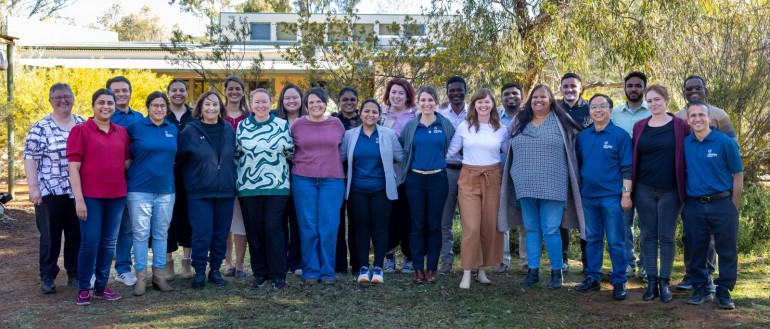
RHC3 team in Mparntwe, Alice Springs
Remote Health Systems and Climate Change Centre
RHC3 team in Mparntwe, Alice Springs
Background:
The Remote Health Systems and Climate Change Centre (RHC3) is being established in Menzies School of Health Research to conduct impactful, placed-based research and evaluation through genuine partnerships. Based in Mparntwe (Alice Springs), RHC3 is leading work to strengthen engagement between researchers, services, communities, planning bodies and other stakeholders to improve services and systems and enable evidence-informed practice and policy. Our work focusses on remote central and northern Australia and involves strategic linkages with national and international networks of health policy, systems and climate change researchers working to improve population health and wellbeing.
RHC3 is built on the legacy of Emeritus Professor John Wakerman who remains a mentor for the team.
Aims:
Improve local services and policy in remote, northern and rural Australia through genuine partnerships with key stakeholders across sectors including health, education, housing, and justice.
Engage in co-design of health systems research and evaluation on issues that are prioritised by stakeholders.
Proactively engage with policymaking processes at local, jurisdictional and national levels to improve knowledge translation and strengthen policy impact of research.
Strengthen linkages between local researchers and global health policy and systems research networks to promote two-way knowledge exchange and collaboration in relevant fields.
Within Menzies, create a platform to grow and coordinate health systems research and evaluation with an emphasis on remote and rural health and social, cultural and environmental determinants of health.
Objectives:
Build and sustain a critical mass of researchers in Mparntwe (Alice Springs)
Improve local services in remote and northern Australia through genuine partnerships with key stakeholders across sectors including health, education, housing, and justice
Engage in co-design of health systems and climate change research and evaluation on issues that are prioritised by our partners
Proactively engage with policymaking processes at local, jurisdictional and national levels to improve knowledge translation for evidence-based policy.
Strengthen linkages between local researchers and global health policy, systems and climate change research networks to promote two-way knowledge exchange and collaboration in relevant fields
Summary:
We aim to strengthen provision of more equitable services and improve the social and environmental determinants of health in remote Australia
We connect communities, researchers, health service professionals and policymakers locally in Central Australia, across remote Australia and internationally
We are committed to improving Aboriginal and Torres Strait Islander health, conducting meaningful co-designed research with local community and service stakeholders, and translating knowledge into practice and policy.
RHC3 Co-Leads:
Contact:
alexandra.edelman@menzies.edu.au
Current Projects:
- NHMRC Centre of Research Excellence for STrengthening Health Systems in Remote Australia (CRESTRA)
- The heat health burden on First Nations communities in under-resourced remote Australia (Wellcome Trust)
- Air in Arnhem: Crowdsourcing air quality, temperature and health data with Yolngu citizens scientists (MRFF)
- Attracting and retaining a health workforce in rural and remote northern Australia (Cooperative Research Centre for Developing Northern Australia)
- Climate preparedness in very remote desert communities (NHMRC)
- Co-design and implementation of workforce retention strategies in remote Aboriginal health services (MRFF)
- Decarbonising the remote primary health care sector: a pilot study in central Australia (HEAL Innovation Grant/MRFF)
- Examining the impact of extreme temperature on primary health care services utilisation in remote central Australia to inform adaptation strategies (MRFF)
- Extreme heat and pregnancy complications: harnessing the diverse Australian climate and population for global answers (Wellcome Trust)
- Evidence of corporate political activity in the unmaking of the minimum unit price policy in the Northern Territory (Foundation of Alcohol Research and Education)
- Head Health and Healing - Empowering Indigenous women and the healthcare workforce to respond to violence-related concussion through co-designed education and training (NHMRC)
- Hot tempers, crime, and hot weather in Alice Springs (CAAHSN/MRFF)
- Optimising digital solutions to improve access to comprehensive primary health care in remote Indigenous communities (Digital Health Cooperative Research Centre)
- Optimising health system integration through innovative models of multidisciplinary primary care in the remote, Aboriginal context (MRFF)
- Strengthening PLace-based health services research collaboration and capacity in Mparntwe (Alice Springs): an important strategy to close the gap in Health outcomes (SPLASH)! (NHMRC)
- StreamlinED – Optimising aeromedical retrievals in remote Northern Territory (MRFF)
- The right workforce at the right time: improving the effectiveness and efficiency of aeromedical retrieval systems in remote Australia (MRFF)
- Unpacking the alcohol policy process: alcohol policy in complex social environments (ARC)
RHC3 is also part of the following national and international partnerships and consortia:
- Healthy Environments and Lives (HEAL) (NHMRC; co-leading the rural and remote health theme and NT Communities of Practice)
- The National Multidisciplinary Primary Care Research, Policy and Advocacy Consortium (MRFF)
- International Consortium on models of sustainable financing, commissioning, delivering, and harmonising, people-centred services, including primary health care to achieve universal health coverage (Asia Pacific Observatory on Health Systems and Policies (APO))
- Roadmaps for NT (R4NT): Working together to create solutions to address road safety in the Northern Territory (National Road Safety Action Grants Program)