
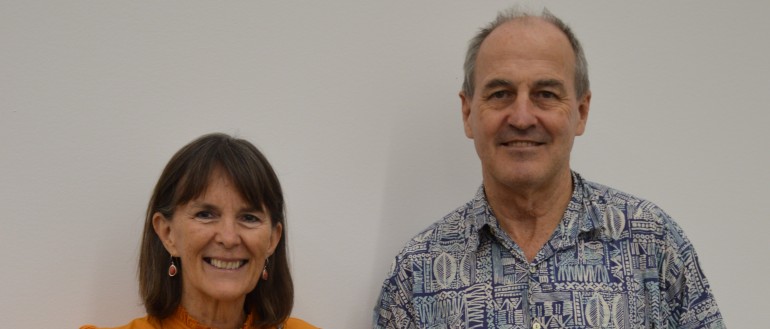
Congratulations to Professor Amanda Leach and Professor Bart Currie for a milestone 30 years of working for Menzies School of Health Research.
Professor Amanda Leach
Amanda began her career with Menzies in 1988 in Alice Springs as a research assistant working on a project on diarrheal disease affecting Aboriginal and Torres Strait Islander people.
She later moved to Darwin to work in the laboratory there, before starting her PhD on otitis media (middle ear infection). Since then Amanda has developed and led microbiological and epidemiological studies of otitis media in Aboriginal and Torres Strait Islander children. Professor Leach’s work has included clinical trials of treatment and prevention strategies, evidence-based guidelines and the national “Care for Kids' Ears” campaigns.
She is now the leader of Menzies’ Ear Health Research Program in the Child Health Division. Earlier this year, Amanda was awarded the Telstra Northern Territory Business Woman of the Year. She is the first researcher to win this award. In 2011, she was awarded the Elizabeth Blackburn Fellowship for top-ranking female applicant in the clinical category.
Professor John Mathews, the founding director of Menzies, believes that Amanda’s success is due to her great ability and commitment.
“Her work has been enriched by the many friends and colleagues she has made and by the students she has mentored,” Professor Mathews said. “The quality of Amanda’s scientific output and leadership has been recognised by multiple grants from NHMRC and other agencies, including her richly deserved personal award as an Elizabeth Blackburn Fellow.
“Very well-done Amanda. As one of your friends, may I cheekily ask: “Are you good for another 30 years?”
Professor Bart Currie
Bart started with Menzies in December 1989, working in a mixed role between Royal Darwin Hospital (RDH), Menzies School of Health Research and training medical students. He is also now the director of both RHDAustralia and HOT NORTH.
Professor Currie’s passion is in coordinating links between clinicians, public health colleagues and other service providers, laboratory scientists and community. For example, he helped establish the Clinical School in Darwin to better connect the specialist hospital expertise with the health needs in communities. He also helped better identify cases of rheumatic heart disease (RHD), to set up a register, and to provide penicillin prophylaxis more effectively.
Early on in his work at RDH, Bart recognised the importance of melioidosis as an exotic infection affecting immune-compromised patients and launched microbiological (and later molecular) techniques to enhance his clinical and epidemiological studies that were to make Darwin a world leader on melioidosis research.
Professor John Mathews, the founding director of Menzies, remembers first hearing about Professor Currie as a young infectious disease doctor working in Papua New Guinea, who also had a deep interest in snake bites and venom.
“Bart has achieved relevance and excellence in everything that he has done as a clinical researcher, leader and mentor; he deserves recognition nationally as well as in Darwin,” Professor Mathews said.
“He has our deep respect, and we are privileged to be able to count him as a friend as well as well as a professional colleague. After 30 years, Menzies will be much the poorer if Bart ever thinks about retiring!”
Thank you both for your contributions to our research which makes a difference to the lives of people throughout Australia and across the region. Your leadership and guidance is improving the health and wellbeing of Indigenous Australians, and positions Menzies as a global leader in tropical research into life-threatening illnesses.